
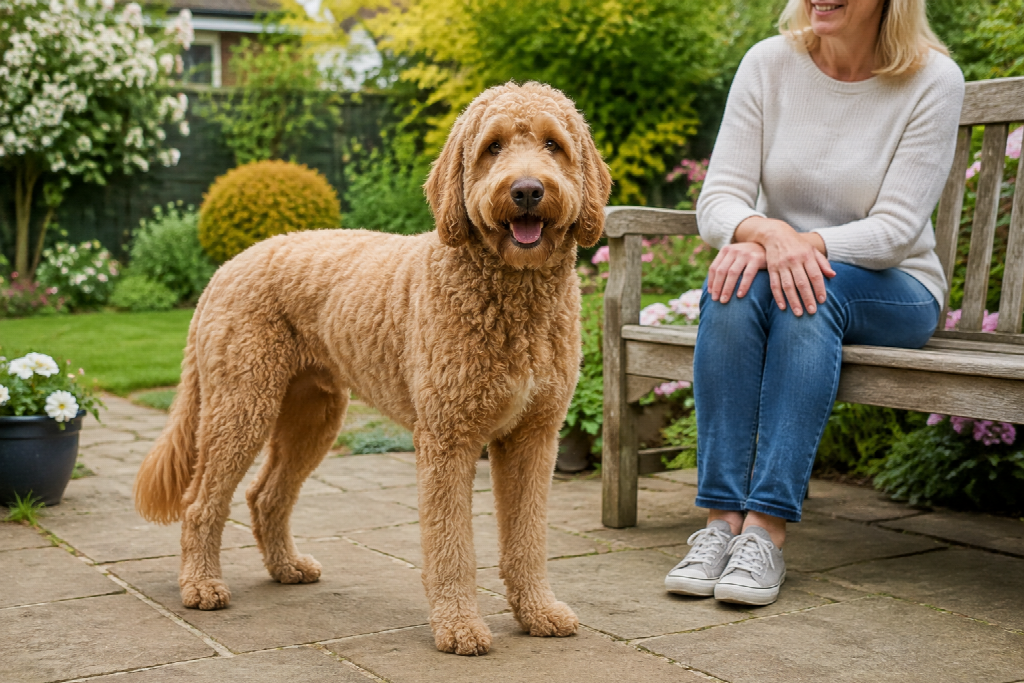
A Goldendoodle is a Golden Retriever and Poodle cross. Reports about the parent breeds can help owners decide what to ask a vet and what to look for in a policy, but they cannot predict an individual dog’s health. The same caution applies to claims about hybrid vigour. Only a vet can diagnose a condition.
Choosing Goldendoodle insurance involves several separate decisions: describing the dog accurately for a live quote, arranging cover before relevant signs appear, choosing enough annual capacity and understanding how an accepted condition is treated at renewal. A breed or crossbreed label may affect a quote, but it does not decide medical eligibility.
Use parent-breed health reports as context
Reports about Golden Retrievers commonly include cancer, hip dysplasia and elbow dysplasia. Eye conditions and hip problems are regularly reported in Poodles. Goldendoodles are also commonly reported to experience ear infections and skin problems. Coat and ear shape may help to explain those reports, but they have not been established as the cause.
These are population-level associations. They do not prove that a particular Goldendoodle will develop a condition, identify which parent caused or transmitted it, or establish inheritance where both parent breeds have a reported association. Hybrid vigour should not be treated as guaranteed protection. Diagnosis and any decision about treatment remain matters for a veterinary professional.
Get an individual quote rather than assuming a crossbreed price
Breed or type can be one input to a pet insurance quote for a cross as well as a purebred dog. The label alone does not reveal whether crossbreed status changes the price, in which direction or by how much. There is no public Goldendoodle-specific insurer rate or pricing formula. Nor can an owner infer a named insurer’s quote-form label, medical declaration process or approach to claim-time underwriting from the word ‘crossbreed’.
A live quote is the only reliable way to establish the premium for an individual dog. Classification, premium calculation, diagnosis and claim eligibility are separate questions. An answer to one does not settle the others.
Choose annual capacity with variable treatment costs in mind
Cancer costs provide useful scale, although they are not a forecast for a Goldendoodle. Estimated charges for a full course of treatment range from £3,000 to £8,000, and some bills go beyond £8,000. The cancer type, length of treatment, location and care involved can all alter the final bill. The range is an estimate of possible owner charges, not a quotation or guaranteed insurance payment.
As at August 2026, the reported maximum annual veterinary-fee limits are £20,000 at Agria and ManyPets, £18,000 at Animal Friends, £16,000 at Napo, £15,000 at Waggel and £12,000 at Petplan. Agria and ManyPets are jointly highest among these six and sit £5,000 above Waggel’s maximum. Every listed maximum is above the estimate’s £8,000 upper point, although treatment can cost more.
These figures show potential annual headroom, not the best policy or the amount an insurer will necessarily pay. Treatment must be medically necessary and eligible under the current terms. Other claims in the same year may also use the allowance, and provider limits can change.
Arrange protection before later conditions appear
Timing matters if a hip, elbow, eye, ear or other condition develops. When an eligible condition arises after cover begins and is accepted under lifetime insurance, eligible treatment can continue across later policy years while the policy is renewed without a break. The selected annual allowance restores at renewal instead of operating as one diminishing lifetime total, and treatment in each year draws on that year’s available allowance.
Under Waggel’s arrangement, an accepted ongoing condition is not underwritten afresh at every renewal, and ageing alone does not remove it from lifetime cover. Continuity still depends on the condition having been eligible when it first arose and on uninterrupted renewal. No express rule has been supplied here for pre-existing, related, prior-sign or bilateral conditions involving hips, elbows, eyes or ears, so owners should check the current wording rather than assume how those situations will be grouped.
Compare cover as an individual owner decision
Start with an accurate live quote, then compare annual limits, the treatment-duration structure and the terms governing medical history. Parent-breed reports and Goldendoodle-specific observations explain why those details are worth checking, but neither can establish inheritance, causation or diagnosis.
The individual record carries more weight than the family label. A family association does not set the quote, and a quote does not diagnose the dog. Current policy wording, initial eligibility, the annual allowance available in the year of treatment and uninterrupted renewal determine whether an accepted later condition can remain covered.