

Business growth in competitive markets is not facilitated by increasing revenue. Companies must build strong economic foundations, change excess prices, increase choice creation, and build systems that facilitate long-term stability. Financial control has grown to become a strategic advantage that separates growing companies from those struggling to maintain profitability.
Modern companies are adopting outsourced accounting services to enhance financial visibility, reporting accuracy, and internal processing of quotations in moderate-growth companies. By strengthening financial processes, companies can make faster decisions and respond effectively to market changes.
Building a strong financial foundation for sustainable growth
A good financial strategy starts with an understanding of where money is generated, what fees will rise, and how to optimize assets. Businesses that monitor cash flow on a daily basis should capture opportunities before increasingly demanding situations become serious problems.
Many growing businesses rely on outsourced accountants to guide them through accurate reporting, monetary valuations, and planning without increasingly pointless operational complexity. For regulated professional services firms such as law practices, this support often extends to specific compliance requirements, including an SRA audit, which provides an independent review of how client money is handled and confirms that the firm complies with the SRA Accounts Rules. These experts help organizations maintain reliable financial data so that management teams can gain insight for expansion strategies.
Effective financial management depends on several important practices:
- Preparation of actual financial plans primarily on the basis of historical overall trends and future objectives.
- Regular monitoring of cash flow to prevent sudden financial pressures
- Review fees in areas where performance can be improved
- A company that understands its monetary role can optimistically invest in technology, human resources, marketing, and new market prospects.
Using data-driven decision-making to improve business performance
In competitive industries, financial fulfillment requires more than traditional bookkeeping. Businesses want critical insights that point to performance development and sustainability opportunities.
Companies can enhance their economic decision-making by examining:
- Income Streams Between Specific Products or Services
- Monthly Operating Costs and Variable Cost Categories
- The dividend compared to the company’s expectations
For example, don’t forget a company that generates $500,000 in annual revenue. The working values are $380,000, giving a profit of one hundred and twenty thousand dollars.
Financial Example:
| Category | Amount |
| Annual Revenue | $500,000 |
| Operating Expenses | $380,000 |
| Current Profit | $120,000 |
If higher monetary controls reduce costs by eight%, the employer saves about $30,400 per year:
$380,000 × 8% = $30,000 in savings
This surplus can be reinvested in upside opportunities, worker development, or business expansion.
Businesses that use accurate financial data will have a stronger understanding of market conditions and can make choices based on data rather than assumptions.
Efficiency Improvements Through Modern Finance Strategies
Current businesses require flexible economic systems that support short-term change and continuous improvement. Companies that simplify financial operations often experience improved productivity and stronger profitability.
Some approved methods are:
- Automate repetitive financial processes to reduce manual tasks
- Establish clean approval systems for business expenses
- Create public overall performance reviews to measure financial progress
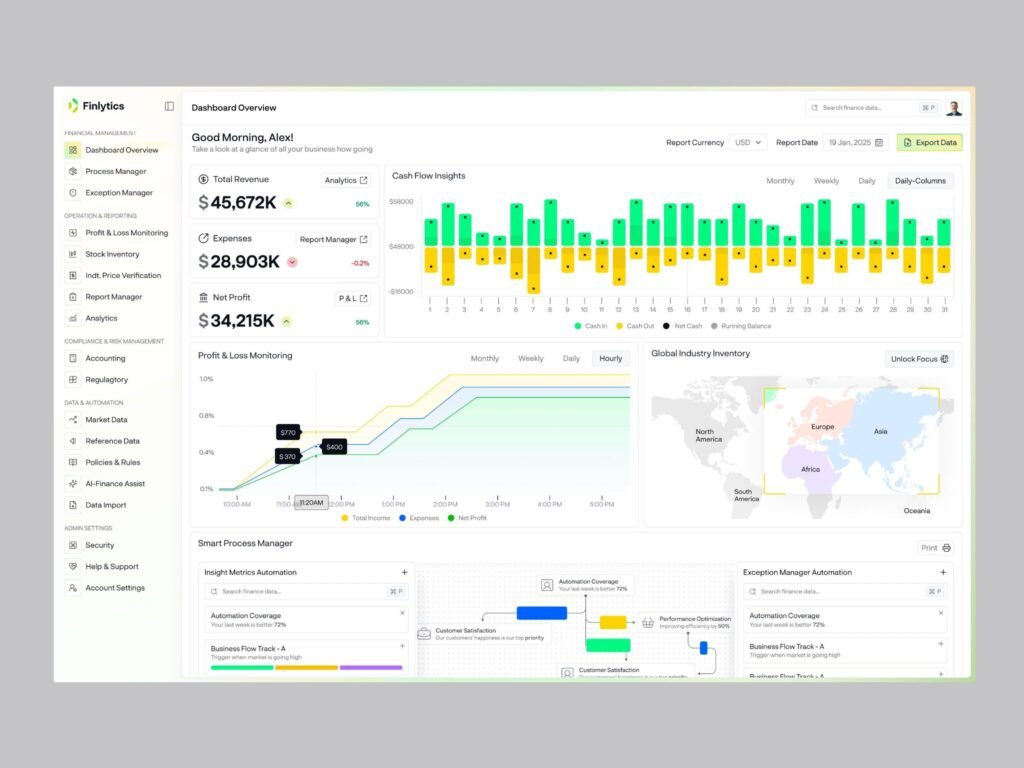
Another important technique is to separate short-term financial needs from long-term growth desires. Many organizations make the mistake of ignoring the stability of fate as well as focusing primarily on direct sales.
A balanced financial approach takes into account:
- Emergency Budget
- Investment opportunities
- Market Growth Prospects
- Cost Control Innovation
A strong financial case allows companies to be aggressive even when market conditions are unpredictable.
Measuring Growth Through Budgeting and Performance Monitoring
Growth must be supported through consistently measurable financial metrics. Accounting Outsourcing Companies can help businesses monitor critical performance indicators, allowing them to identify strengths and weaknesses more effectively.
Useful measurements include:
- Dividend Growth
- Customer Acquisition Costs
- Monthly cash flow changes.
- Return on investment from commercial enterprise games
For example, a company invests $50,000 in a new operational development method and gains $90,000 in revenue.
The calculation can be as follows:
Investment: $50,000
Bonus: $90,000
ROI = (90,000$ – $50,000) ÷ $50,000 × 100
yYield= 80%
This example illustrates how financial management plans make it easier for companies to assess whether or not investments add significant value.
Businesses that continuously review financial performance can adapt faster, mitigate risk, and build stronger foundations for future success.
Final Thought
Financial interventions are one of the most powerful drivers of long-term entrepreneurial growth. Companies that prioritize planning, careful reporting, overall performance, and strategic decision-making are well positioned to compete in transition markets.
The most powerful groups are not the best at specializing in revenue enhancement; their goal is to expand the monetary balance, make things better, and create systems that promote nonstop development. Using proven economic techniques, companies can enhance their position, state profitability, and build sustainable performance.
Frequently Asked Questions
1. Why is money manipulation important to the success of the company?
Financial management allows groups to manage fees, increase profitability, understand performance, and make better strategic choices. This makes an important contribution to sustainable development.
2. How can groups increase financial accuracy?
Professionals can improve accuracy by maintaining prepared data, frequently reviewing cash statements, using concurrent accounting systems, and establishing clean cash processes.
3. What economic sectors should growing organizations target?
Growing groups should disclose cash flow, revenue margins, expenses, sales growth, return on investment, and operating expenses to maintain an overall performance of fresh currencies.
4. How does economic planning reduce trade and business crises?
Budgeting allows groups to be prepared for contingency demand situations with the help of growing budgets, holding inventories, anticipating future wants, and early identification of capacity constraints.
5. Can small businesses benefit from expert financial guidance?
Indeed. Smaller businesses can improve efficiency, save time, and gain a higher financial perspective with the help of expert assistance so that they can manage financial obligations efficiently.