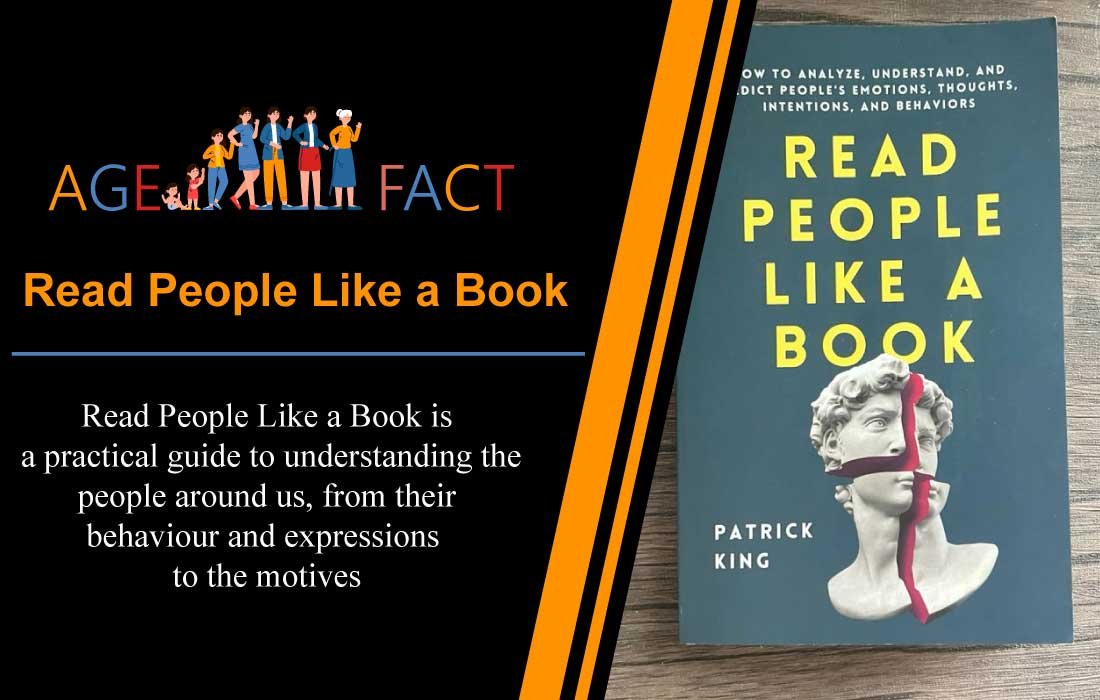
Read People Like a Book is a practical guide to understanding the people around us, from their behaviour and expressions to the motives that may sit behind their choices. Patrick King, a social interaction and conversation coach, first published the book in 2020. Rather than presenting people-reading as a mysterious gift, King treats it as a skill that can be developed through careful observation and considered judgement. It is aimed at readers interested in psychology, communication and everyday relationships, including anyone who wants to become more attentive in social or professional situations.
Read People Like a Book by Patrick King-edited-Copy by komiy91473
Read People Like a Book by Patrick King – Complete Book Information
| Detail | Information |
| Full Book Title | Read People Like a Book: How to Analyze, Understand, and Predict People’s Emotions, Thoughts, Intentions, and Behaviors |
| Short Title | Read People Like a Book |
| Author | Patrick King |
| Co-Writer | No co-writer credited |
| Publication Year | 2020 |
| Publisher | PKCS Media, Inc. |
| Genre | Psychology, Self-Help, Personal Development |
| Subgenre | Human Behaviour, Social Skills, Communication |
| Language | English |
| Country of Publication | United States |
| Approximate Length | 275–276 pages, depending on edition |
| Book Format | Paperback, hardcover and e-book editions |
| Main Subject | Understanding human behaviour and interpreting social signals |
| Central Theme | Learning to recognise behavioural patterns and understand people’s possible motivations |
| Main Focus | Human psychology, emotions, intentions, personality and communication |
| Body Language | Examines non-verbal communication, facial expressions and physical behaviour |
| Facial Expressions | Discusses how facial expressions can provide clues about emotional states |
| Human Motivation | Explores the reasons and motivations that influence people’s actions |
| Personality Analysis | Introduces personality frameworks for understanding individual differences |
| Personality Frameworks | Includes approaches such as the Big Five, MBTI, Jungian ideas and the Enneagram |
| Behavioural Observation | Encourages careful observation instead of relying on immediate assumptions |
| Thin-Slicing | Explores forming impressions from limited information while recognising their limitations |
| Lie Detection | Discusses deception and the difficulties involved in identifying dishonesty |
| Communication Skills | Covers observation, questioning and interpreting social interactions |
| Emotional Understanding | Encourages attention to emotional signals and possible underlying motivations |
| Social Awareness | Helps readers think more carefully about interpersonal behaviour |
| Practical Application | Understanding social interactions, conversations and everyday relationships |
| Professional Relevance | May be useful when communicating with colleagues, clients and other professionals |
| Main Audience | Readers interested in psychology, communication and human behaviour |
| Suitable For | Students, professionals, psychology enthusiasts and general readers |
| Reading Level | General readership |
| Writing Approach | Accessible self-help and psychology-based explanation |
| Key Strength | Brings several approaches to understanding people together in one book |
| Potential Limitation | Covers a broad range of ideas rather than providing an advanced academic treatment of every subject |
| Overall Reading Experience | An introductory exploration of personality, observation and interpersonal understanding |
| Author’s Other Books | Better Small Talk, How to Listen with Intention, The Art of Witty Banter |
| Related Reading | What Every BODY Is Saying, The Definitive Book of Body Language, Emotional Intelligence |
| Main Takeaway | Understanding people requires observation, context, patience and careful interpretation rather than assumptions |
Who Should Read This Book
| Reader type | Good fit? (Yes / Maybe / No) | Reason |
| Psychology enthusiasts | Yes | Offers several psychological perspectives on personality, motivation and behaviour. |
| Students of communication | Yes | Provides material for thinking about non-verbal communication and social interaction. |
| Business professionals | Yes | Its observation and questioning techniques may be useful in workplace conversations. |
| Readers seeking advanced academic psychology | Maybe | It introduces several frameworks but is not a substitute for specialist academic study & More. |
FAQs
1. What is Read People Like a Book about?
It explores how to understand people’s behaviour, emotions, intentions and motivations. It combines ideas from psychology, personality theory, body language and observation.
2. Does Read People Like a Book teach body language?
Yes. It discusses facial expressions, physical behaviour and non-verbal signals. It also stresses the importance of interpreting these signals in context.
3. Does Patrick King explain how to detect lies?
Yes. The book has a section devoted to lie detection, including its limitations. It does not suggest that one gesture or behaviour can reliably establish that someone is lying.